Wednesday, January 23, 2013

The day after the funeral, we packed up for three days and two nights of hiking around the Torajan highlands.  My backpack was the size of the one a 3rd grader might take to elementary school and my friend  was recovering from a serious back injury, so we managed to pack very light: clothes to sleep in, sunscreen, bugspray, and a toothbrush. And of course a camera, because this trek was mostly spend taking pictures and yelling every time we came around a bend, "oh my god! it actually gets prettier!"

Walking is one of my favorite activities. So is talking with a good friend about all of life's possibilities and laughing every time I ended up knee-deep in mud. And for whatever reason, I have an aesthetic obsession with rice paddies, that only grows if the rice paddies are terraced up hillsides. Add all that together and I ended up with an amazing trip.

Traditional Torajan houses. Called Tongkonon. They have saddle-backed roofs and elaborate paintings.

This particular house was over 700 years old, you can still see the paintings behind the leafy overgrowth.

It was so pretty.

Really really pretty.

Ughhh. So pretty. And we ended up with miraculously perfect weather. Trekking during the rainy season, but it only poured in the evening. Both times about 5 minutes after we safely made it to shelter.


It was a perfect trip. We had an excellent guide who led us through rice fields and bamboo forests. We stayed the night in one of the traditional houses, sleeping up in a loft under the arced roof. We met a lot of nice people who graciously let us meander through their fields. 

Toraja is an absolutely beautiful part of Indonesia. I left feeling so happy and so lucky that I live here. 

Tuesday, January 15, 2013

Tana Toraja is a magical place.

I had the most wonderful time in the days I spend in the highlands of South Sulewesi. The trip was an anthropology class brought to life, I actually studied the Torajans when I took anthropology classes in college.

Our very first day in Toraja we arrived by night bus and went straight to a tourist information center. We found out (such good luck!) that there would be a funeral happening that day, and we would be welcome to attend.

Funerals in Toraja are an interesting business. Long before the Dutch, before Christianity, the Torajans were an animist people that traditionally celebrated life and death with elaborate rituals. After ignoring the area for a long time, missionaries arrived in the early 20th century and brought Christianity to the area (a response to the fact that the Dutch had become concerned by the spread of Islam in other parts of Sulewesi). Toraja will celebrate the 100th anniversary of the arrival of Christianity next year. Most of the Torajans I met identify themselves as Christians, but they still participate in many of their earlier traditions.

Today, funerals are the big event in Torajan society. They are expensive elaborate rituals that can last for days. We showed up on the first day of what would be a 5 day ceremony. The man who had died was a high-ranking member of a well to do family. He had actually died three years ago, and the family had spend the intervening years saving and planning for the event.

The site of the ceremony was outside of the family's house (the tongkonan - more on the architecture later). Large shelters were erected for the guests to sit. We showed up with our guide and gave one of the family members a gift (a carton of cigarettes, a pittance compared to the gifts the real guests were bringing) then watched as family groups from as far away as Papua arrived. The guests all brought water buffalo and pigs as offerings to the deceased - it is a reciprocal exchange, so men walked around spray painting each animal and announcing who it came from. Later this family will have to bring an equal or greater offering to the next funeral. Turns out the water buffalo at these funerals can be enormously expensive. A normal buffalo might cost $7,000 of $8,000 USD, but some of them are rare albino buffalo that can cost up to $30,000 (the whiter they are, the more they cost). I thought the albino buffalo were actually pretty weird looking (they have blue eyes) but being a genetic freak apparently makes you worth a lot of uang.

After everyone arrived, the slaughtering began. Most of it was hidden from my immediate view, but I did still hear the squeals and see the blood spurting into the air. The slaughtering would continue for the next couple days, but they got enough of it done that we could eat boiled water buffalo for lunch (not as bad as you might expect it would be).

The experience of the funeral was incredible. I was fascinated to see such an elaborate and traditional ritual come to life. I'd worried before we got there that we'd be out of place or unwanted, but in a way that felt like the weddings I go to, people seemed to think the more the merrier. Everyone was friendly to us, they took lots of pictures of us (but this time I too pictures of them too!), and I had a few conversations with sweet old Bapaks who appreciated my limited Bahasa skills.
the main courtyard - pigs are tied up, squealing occasionally


young family members, dressed up and waiting to greet arriving guests


guests arrive! wearing cool hats!


the courtyard. note the kerbau head in the foreground


the water buffalo are offered to the deceased 


Sunday, January 13, 2013

I spent Christmas in Samarinda with friends, we made dinner, watched "A Christmas Story," and made lots of phone calls home - I also watched and rewatched an amazing video of all my friends singing "Rudolf the Red-Nosed Reindeer" for me.

The next day I took a flight to Makassar to meet up with a friend who was flying all the way from Germany to spend a week traveling around Indonesia with me.
It was a bit of a Christmas miracle that my friend was able to come, and that I found her at the airport, because we didn't really do a very good job of planning our travels, but sometimes things work out anyways. We spent a day together in Makassar, eating the famous local soup and wandering around the harbor.

It seems like I end up taking hundreds of pictures of boats every time my camera and I get close to water. This time we had great lighting, colorful boats, and boisterous children.


Little hoodlums. They just wanted to all be in the photo.

Really wanted to be in the photo.

But it was still a lovely place and a peaceful evening.

That night we went out to a nice dinner and almost missed the night bus we were taking up to Toraja because I sometimes forget how military time works. Luckily, the night bus left late, so we made it with a bit of time to spare.

Next post: Muddy, Bloody Tana Toraja!

Wednesday, January 9, 2013

Fun facts about jellyfish:


-In isolated environments, jellyfish can evolve to be sting-free - like the ones my friend and I are smooching in the photo

-The life cycle of a jellyfish is fascinating! They can alternate between polyp and medusa phases. During the polyp phase the jelly is generally a planted stalk with a tentacled upward-facing mouth, but it can also ride around on bits of plankton or fish. The medusa phase is what you picture when you think about jellies.

-Jellyfish can reproduce sexually or asexually.

-Some of them might even be immortal!

-Jellyfish were around before the dinosaurs, they've been to outer space, and in some parts of Asia they are considered to be a culinary delicacy.

Thanks to my friend, Sarah, for the picture and this smithsonian blog for the facts.

One of my favorite things about teaching at Outdoor Science school was the chance to teach impressionable young minds all of my favorite fun science facts (like the one about platypus lacking mammary glands, so instead mothers basically sweat milk for their babies to lick up)

Living and traveling around Indonesia has got me thinking about lots of new things, and along the way, I've learned some great new fun facts.

Here's what I just learned about Volcanoes:

-The 1883 eruption of Krakatau in Indonesia is thought to have released 200 megatons of energy, the equivalent of 15,000 nuclear bombs. Even though the island was uninhabited, huge tsnumanis and showers of burning ash killed 36,000 people. It generated the loudest sound ever recorded in history

-The Lake Toba supervolcanic eruption nearly 75,000 years ago in Indonesia plunged earth into a volcanic winter (known as the Millennium Ice Age) and was responsible for the formation of sulfuric acid in the atmosphere. It may have so hugely depleted the human population that it caused a genetic bottleneck affecting the genetic inheritance of all humans alive today. 
-There are about 1,500 active volcanoes in the world, the majority along the Pacific Ring of Fire (where I happen to live!). 20-50 volcanoes erupt each year.


And then (this is not actually a fact, but a general impression): 
-Standing on the edge of an active volcano is a surprisingly eerie experience. It also reeks of sulfur.

Monday, December 24, 2012

Photos from Labuan Bajo, Rinca and Komodo
I spent the first week of my winter break traveling with two friends around Flores, one of the smaller islands east of Bali and Lombok.

This is the sunset taken from my hotel balcony my first night in Labuan Bajo. The airport had decided not to put my luggage on the plane, and I was waiting on friends to show up the next day, but this view and a lukewarm beer made me feel a lot better about things.

The next day a new friend took me on a motorbike tour of the island. We drove past a library he built out of recycled bottles and talked about the local environmental movement. 

Went caving.

Saw a bat. Our guide pointed this baby bat out to us and said "use your flash, make sure you take a good picture"

Hiked out to a waterfall. See the rain clouds lurking in the distance? About 15 minutes into our hike, the heavens let loose and we were immediately soaked through. But we kept on, slipping and sliding down a jungley slope, grateful for having remembered to put the cameras in the drysack.

The waterfall. We had to ford (swim) the river to get even this close to the big falls, our guide said we couldn't go further, because the water was rising fast.

So we played around in this baby waterfall.

Sailing out to Manta Point to go scuba diving with manta rays.

Snorkeling. I saw a cuddlefish!

Komodo Dragons!

In Komodo National Park. Sacrifice to some god of Komodo Dragons? Or just to keep things interesting for the tourists?

This is the bud of rafflesia arnodii, the biggest flowers in the whole world. The bud was 10" high. The books say it might also be the stinkiest flower in the world, it smells like rotting death.

That log-like thing in the background? Yep. That's a komodo dragon. They can run up to 18km/hr, have very sharp claws, dirty mouths, and are capable of bringing down a water buffalo. But luckily, this one isn't feeling very hungry.

Monday, December 17, 2012

One of my weekend hobbies here in Samarinda is weddings. Weddings are great. I haven't been to an actual ceremony, but its the reception the day after that is the main attraction. Weddings are a huge event, you invite everybody you know and hundreds if not thousands of people show up, sign in, get a small present like a fan or a tissue paper cover*, drop some money off as a gift, greet the bride and groom, pose for a picture, eat some food and then skedaddle for the next wedding. As a wedding guest, you can be in and out the door in ten minutes, five, if you're in a hurry.

However, for my sixth wedding here, I was not just a wedding guest, I was part of it! Yesterday was the wedding of the daughter of one of my Ibus at school. She invited me to come be a part of the wedding party as one of the official hand shaker people who greets guests as they come in the door. The job of the hand-shaker person, might not be as important as that of the guest-book guard, the present passer-outer, or the food server, but it was exactly right for me. 

I got to get dressed up in traditional kebaya. The skirt was of a long, patterned red and gold fabric, woven with sparkly golden fibers, and the top part is a lacy and bejeweled tunic top. In the picture below you seem me after getting dressed that morning. Kebaya Barbie is drinking lots of coffee, and obviously (and unsurprisingly) has not been doing much housekeeping this week.


We got to the wedding around 10:00 and took some pictures with the bride and groom before the guests arrived. I also had a chance to eat a quick bowl of chicken soup and some beef curry (not an abnormal breakfast option).

As guests began to show up, we took our places at the entrance of the big reception room. I stood with some of the Ibus who are teachers at my school, and some who I hadn't met before, all of us dressed in the the same outfit, and for the next four or five hours, I touched hands with every single woman that walked into that room, and probably about half the men. Now, this wasn't exactly a handshake, Indonesians don't like the firm grip, American-syle handshake, instead you keep your hands in a prayer-shape and lightly shake them around the other person's hand and then touch your chest, maybe with a little head bow thrown in. I did that a thousand times, and one of the best parts was watching people do a double-take realizing there was a bule in the receiving line.

Bu Nur and me

After a few hours, my feet were hurting and the rest of me was sweating; I took a few breaks, but I think I managed to put up a good show as an official member of the greeting party.  It was a really good experience to feel part of a community. There were lots of smiles, photos, babies, and food, so it had everything a good wedding party needs (except the dance floor and the open bar, but I wasn't expecting that). I had fun meeting new people, practicing my bahasa, and watching all the guests decked out in colorful, sparkling wedding clothes.

When Bu Nur picked me up that morning, I tried to figure out the appropriate way to say congratulations. I tried "Selamat Perkawinan" which would mean basically just be wishing "good wedding," but instead found out it is better to say "Selamat mulai hidup baru" which is more like "congratulations on beginning your new life." I like that. 

These Ibus are helping to serve delicious wedding food, soto ayam (chicken soup) and sate (satay...duh)

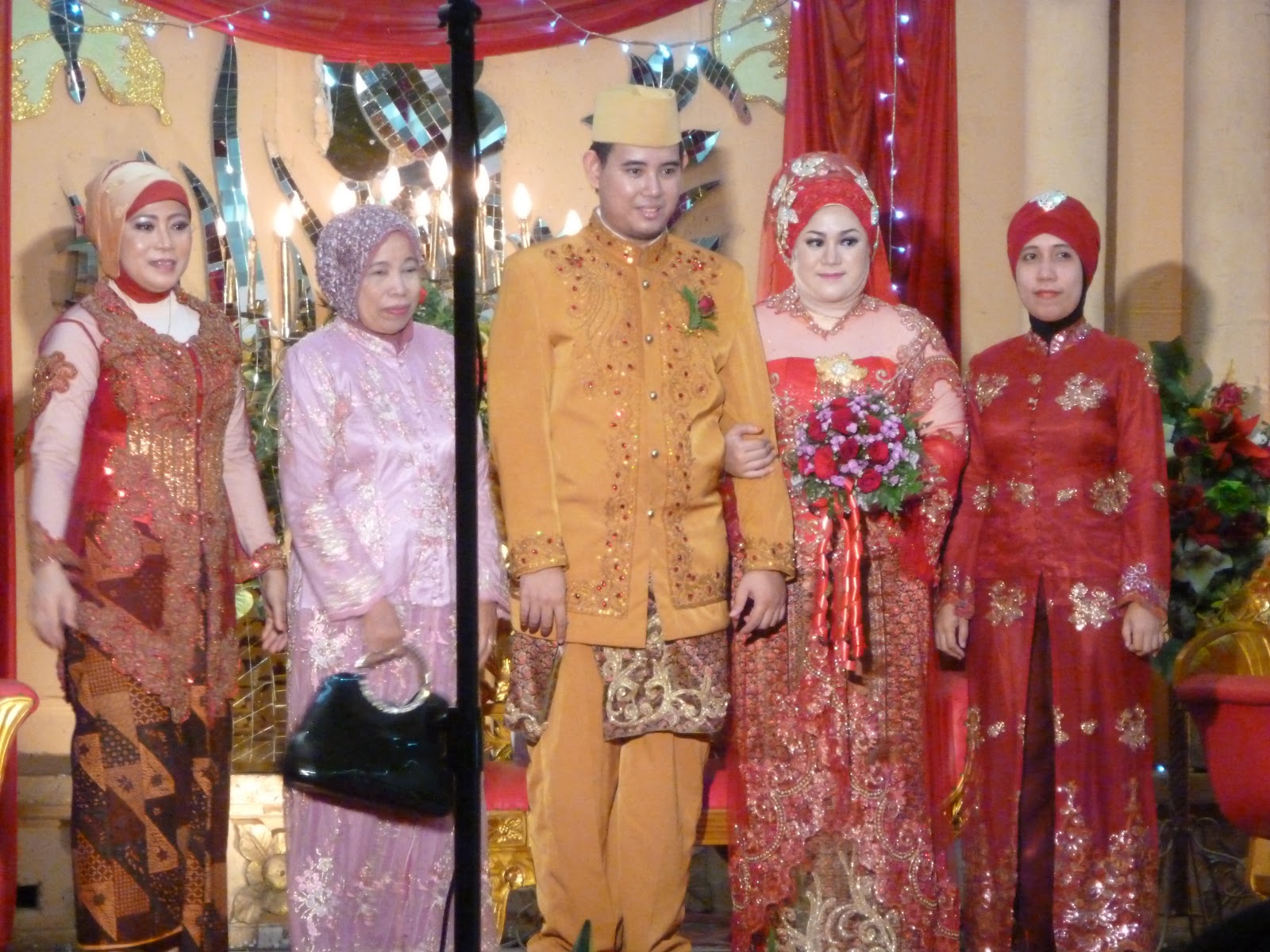
Bride, groom, and assorted relatives. Those are some excellently sparkly clothes!

Some of the wedding party ibus with the bride and groom


*Fun Fact. I now own three, dark red, lacy tissue box covers. If I can keep this up, I know what everybody back home will be getting as presents from Indonesia